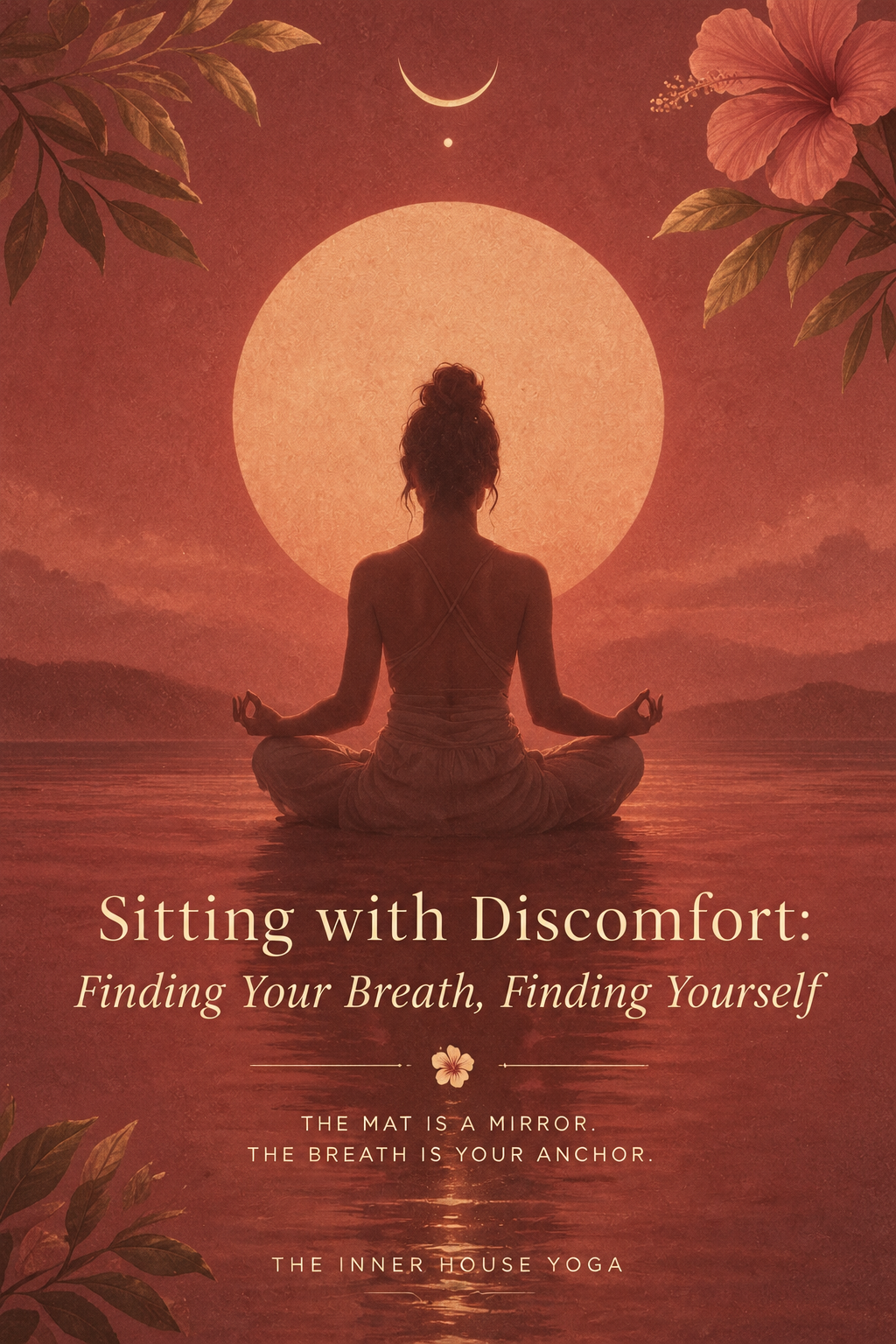
Sitting with Discomfort: Finding Your Breath, Finding Yourself
The mat is a mirror. The resistance we meet in our practice can teach us something about the way we meet life.
There is a particular kind of wisdom in learning to stay.
To stay when something feels uncomfortable. To breathe when the instinct is to tense. To pause when everything within us wants to escape, react or find a way to make the feeling disappear.
We live in a world that encourages us to seek comfort, distraction and immediate relief. When something feels difficult, we often look for a way out. We scroll, overwork, withdraw, fill the silence or convince ourselves that we need to fix what we are feeling before we can move forward.
And yet, what if we didn't always need to escape discomfort?
What if, instead, we could learn to meet it with curiosity, breathe into the moment and allow ourselves to be present with what is?
This is one of the things yoga continues to teach me. And it is one of the reasons I believe our time on the mat can become so much more than a physical practice.
The mat is a mirror
When we step onto our mat, we bring our whole selves with us.
We bring our thoughts, our worries, our expectations, our habits and the experiences we may not even realise we are carrying. We bring the parts of ourselves that feel strong and capable, alongside the parts that feel uncertain, resistant or vulnerable.
And then we begin to move.
Perhaps we find ourselves in Warrior II, holding the posture for a few more breaths than we'd like. Our legs begin to tremble. Our shoulders feel heavy. Our mind starts counting the seconds until we can come out.
Perhaps we meet a tightness in the hips, a limitation in the shoulders or a posture that looks effortless for someone else but feels entirely different in our own body.
Or perhaps the discomfort isn't physical at all. We become frustrated because we cannot do something we used to do. We compare ourselves to the person beside us. We judge our bodies for having limitations. We become impatient with ourselves for not being further along.
Notice what happens in these moments.
Do we immediately resist? Do we hold our breath? Do we become critical of ourselves? Do we force our way through, or do we abandon the posture altogether?
There is no right or wrong answer. The invitation is simply to notice.
The mat is a mirror because it gives us the opportunity to observe how we meet resistance.
And sometimes, the way we respond to a challenging posture resembles the way we respond to challenges beyond the mat.
When life becomes uncomfortable, do we tighten our grip? Do we rush to find a solution? Do we react before we have understood what is happening? Do we avoid the feeling because we are afraid of what might surface if we sit with it?
Our practice gives us a space to explore these patterns, not to judge ourselves for them, but to become more aware of them.
Finding the breath within the discomfort
The breath is one of the most valuable tools we have in our practice.
When we encounter something challenging, our breathing can become shallow, restricted or hurried. We might clench the jaw, grip the muscles or unconsciously hold our breath as though bracing ourselves against the experience.
The body responds, and the mind often follows.
This is where we can begin to practise something different.
Rather than immediately trying to escape the sensation, we pause. We notice the breath. We allow the exhale to soften, without forcing it. We give ourselves a moment to feel the ground beneath us and become aware of the support available to us.
Can we soften the jaw?
Can we release unnecessary tension in the shoulders?
Can we breathe without demanding that the sensation disappear?
Sometimes, simply bringing our attention back to the breath changes our relationship with the experience. The posture may still feel challenging, but we are no longer meeting it in quite the same way.
We are creating a little more space between the sensation and our reaction to it.
This is not about using the breath to force ourselves to tolerate everything. It is about learning to recognise what is happening within us and responding with greater awareness.
The breath becomes an anchor. It brings us back from the stories we tell ourselves about the discomfort and into the reality of the moment.
One breath at a time.
One moment at a time.
One posture at a time.
Discomfort is not the same as pain
There is an important distinction to make here.
Sitting with discomfort does not mean ignoring our body's signals, overriding our limits or pushing through pain in the name of discipline.
Yoga is not about proving how much we can endure.
There is a difference between the unfamiliar effort of building strength, the intensity of a sustained posture, the restlessness of the mind and a sensation that signals something is wrong.
Sharp, sudden, escalating or concerning pain is not something we need to breathe through. Numbness, tingling, dizziness or feeling unwell are also reasons to stop and reassess. We can come out of a posture, change our position, rest or ask for support.
Sometimes the most skilful thing we can do is stay.
Sometimes the most skilful thing we can do is leave the posture.
Both require awareness.
At The Inner House, I want the practice to be a place where we learn to listen to our bodies rather than fight against them. We are not trying to force every body into the same shape. We are exploring how to create support, stability and space within the body we actually inhabit.
The question is not simply, How much can I tolerate?
It is also, What am I feeling? What is this asking of me? And what would a thoughtful response look like?
That is where the practice begins to deepen.
Building resilience, not resistance
Resilience is often mistaken for the ability to keep going regardless of how difficult something becomes.
But genuine resilience is not about becoming harder, more rigid or less sensitive to what we feel.
It is about developing the capacity to meet life's challenges without losing our connection to ourselves.
On the mat, we might learn to remain present for a few more breaths instead of immediately reacting to discomfort. We might notice frustration arising without allowing it to dictate our next movement. We might recognise the urge to compare ourselves with someone else and gently return our attention to our own practice.
These are small moments, but they matter.
Each time we notice a familiar reaction, we have an opportunity to explore a different response. Each time we meet a challenge with awareness rather than automatic resistance, we practise creating a little more room between what we experience and what we do next.
We begin to understand that a difficult moment does not necessarily require an immediate reaction.
We can pause.
We can breathe.
We can gather information before deciding what comes next.
And we can discover that we have more options than our first instinct might suggest.
This is the resilience I am interested in cultivating through yoga: not the ability to endure everything, but the ability to remain connected to ourselves while responding wisely to what life brings.
Taking the practice beyond the mat
Life will inevitably bring moments we cannot stretch our way out of.
Difficult conversations. Disappointment. Uncertainty. Grief. Frustration. The discomfort of not knowing what comes next.
We cannot always change our circumstances, and we cannot always make an unpleasant feeling disappear simply because we would prefer not to experience it.
But we can begin to explore how we meet those moments.
Perhaps we can sit with a difficult conversation without immediately preparing our defence.
Perhaps we can pause when something triggers us, giving ourselves time to understand what we are feeling before responding.
Perhaps we can allow sadness, anger or anxiety to be present without judging ourselves for experiencing it or rushing to make it go away.
Perhaps we can become curious about another person's perspective instead of assuming we already understand their intentions.
This does not mean accepting harmful behaviour, abandoning our boundaries or remaining in situations that are not good for us. Sometimes a thoughtful response involves speaking up, saying no, creating distance or walking away.
The difference is that we are learning to respond with awareness rather than being carried entirely by our first reaction.
When we can recognise our own discomfort without immediately projecting it onto the world around us, we create space for compassion — for ourselves and for others.
We become more willing to listen.
More able to consider another perspective.
More aware of the assumptions and patterns through which we experience life.
We may not always get it right. The practice is not to become perfectly calm, endlessly patient or unaffected by difficulty.
It is to notice when we have been swept away, and to find our way back.
Again and again.
Your body is your house
At The Inner House, one of the ideas that guides my teaching is that your body is your house.
It is the place you inhabit every day, through every experience, every relationship, every season of your life.
And yet, how often do we treat our bodies as though they are projects to be corrected? How often do we judge them for their limitations, compare them with other bodies or believe that we must change them before we can feel at home within them?
I am drawn to the idea of yoga as a way of learning to inhabit our bodies more fully.
To build a foundation of stability.
To develop strength that supports rather than restricts us.
To create space where we habitually grip or brace.
To become aware of the patterns we carry and the ways we respond to the world around us.
A house needs both structure and space. It needs foundations that can support it, rooms that can be lived in and the care and attention that allow it to remain a place of shelter.
Our bodies are no different in that sense.
When a posture feels challenging, we have an opportunity to explore the architecture of our own experience. Where are we gripping? Where have we lost our breath? Where are we trying to force something that might benefit from more support? Where might we need to soften, and where might we need to build strength?
We are not trying to make every room look like somebody else's.
We are learning how to live in our own house.
And perhaps, through that process, we begin to offer ourselves the same patience and care we would offer a place we love.
The practice of staying
The next time you step onto your mat and encounter discomfort, see if you can pause before deciding what to do.
Notice the sensation without immediately labelling it as good or bad.
Notice the thoughts that arise around it.
Notice whether your breath changes, whether your body begins to grip, whether frustration or impatience starts to take over.
Then gently return to your breath.
Allow the exhale to soften. Feel the support beneath you. Ask yourself whether you can remain comfortably and safely in the posture, or whether you need to adapt, rest or come out.
There is no prize for staying longer.
There is no failure in choosing a different shape.
The practice is in paying attention.
And when you leave your mat, perhaps carry that same awareness into the rest of your day.
The next time life feels uncomfortable, perhaps you can find a moment to pause before reacting. Take a breath. Notice what is happening within you. Give yourself enough space to choose your response.
You may still feel frustrated. You may still feel uncertain. The situation may not change at all.
But your relationship with the moment might.
Because the resistance we experience on the mat and the resilience we cultivate through our practice can offer us a way to explore how we meet life itself.
Not by becoming immune to discomfort, but by learning that we can meet some difficult moments with steadiness, curiosity and care.
Not by forcing ourselves to stay, but by understanding when staying serves us and when letting go is the wiser choice.
Not by trying to become someone else, but by becoming more present to the person we already are.
The mat is not an escape from life. It is a place to practise meeting it.
So breathe.
Notice.
Stay, if it is right for you.
And remember that coming home to yourself is not about getting every posture right. It is about learning, breath by breath, to inhabit your own body with a little more awareness, compassion and grace.
Move your body with purpose and intention.
With warmth,
Persia Alexandria
The Inner House Yoga 🌿