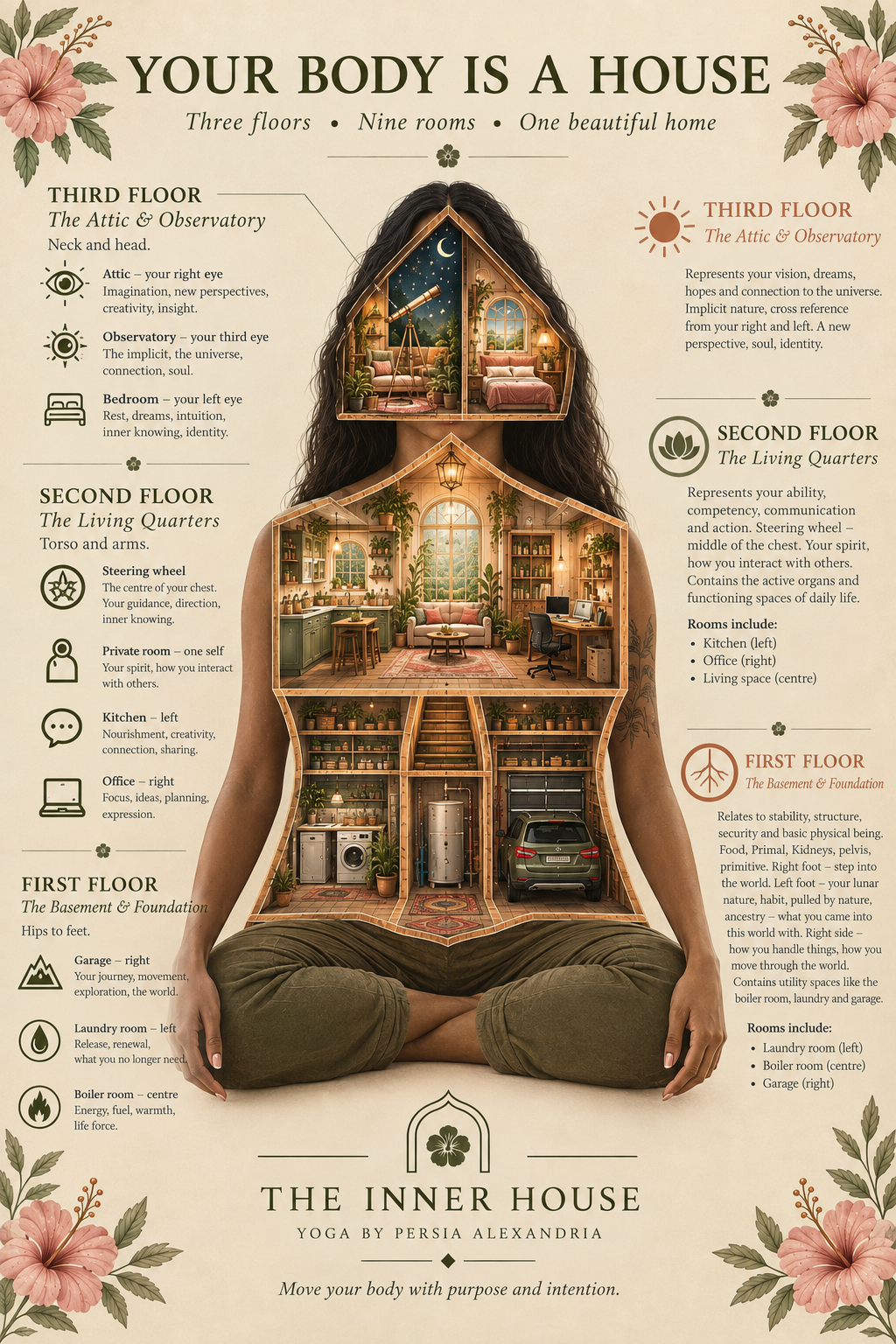
Your Body Is a House: The Three Floors of the Body in Katonah Yoga 🏡
What if you stopped thinking of your body simply as something you move, stretch or exercise — and started thinking of it as a house?
A house that you live in every single day.
A house with foundations, living spaces, rooms, storage, windows, doorways and an attic. A house that needs maintaining, strengthening, cleaning, resting and, sometimes, simply coming home to.
This is one of my favourite metaphors within Katonah Yoga: the body as a house.
It is also one of the reasons the metaphor of The Inner House feels so meaningful to me.
In Katonah Yoga, developed by Nevine Michaan, the body is imagined as an archetypal house. It can be understood through a three-floor structure, with each floor representing different aspects of our physical, emotional and energetic experience.
Rather than seeing the body as a collection of separate parts, this gives us a map — a way of using imagination, sensation and awareness to understand ourselves more deeply.
So, let's take a little tour through your house...
🏡 The First Floor: The Basement & Foundation
Hips to feet
The first floor is the foundation of the house.
It relates to stability, structure, security, basic physical needs and our relationship with the earth.
Think about the foundations of an actual home. Before we worry about decorating the rooms upstairs, we need somewhere solid to stand.
The same is true in the body.
Our feet connect us to the ground. Our legs carry us through the world. Our pelvis gives us a centre of gravity and a place from which we can organise ourselves.
Within the Katonah framework, this floor can also relate to our more primitive and instinctive nature — our habits, ancestry, what we inherited and what we came into this world with.
There is something wonderfully grounding about this idea.
Our feet can be thought of as our relationship with the world.
The right foot can be explored as the foot that steps into the world — how we meet and handle what is in front of us.
The left foot can be explored through a more lunar, receptive quality — our habits, our relationship with nature and the ancestral patterns we carry.
The first floor is therefore not just about physical strength.
It asks:
Do I feel grounded?
Do I have a foundation?
Do I feel secure enough to inhabit my body?
What am I carrying that belongs to my history?
What allows me to stand firmly in the world?
In our house, this is where we might imagine the garage, laundry room and boiler room — the practical spaces that keep everything functioning.
These aren't necessarily the glamorous rooms of the house, but they are essential.
And our bodies are the same.
We need maintenance.
We need warmth.
We need fuel.
We need somewhere to put what we no longer need.
🌿 The Second Floor: The Living Quarters
Torso and arms
Now we move upstairs.
The second floor is the living space of the house.
This is where we interact with the world and with one another.
In the Katonah framework, the second floor relates to ability, competency, communication and articulation.
If the first floor asks, “Can I stand?”, the second floor begins to ask:
“How do I live?”
How do I use my body?
How do I express myself?
How do I communicate?
How do I interact with other people?
Our arms reach into the world. Our hands touch, create, hold and communicate. Our chest and torso house many of the organs that keep us functioning and alive.
There is also a beautiful idea here of the steering wheel — the middle of the chest — as a place from which we can navigate our experience.
And within this floor we can imagine a private room: a room that represents the self.
The part of us that exists beyond our roles, responsibilities and relationships.
Our spirit.
Our individual experience.
The way we meet ourselves — and then how we choose to meet others.
This floor is about capacity.
Not simply “Can I do the pose?”
But:
How much capacity do I have?
How do I organise myself?
How do I communicate?
How do I respond rather than simply react?
How do I use what I have?
Just as the living quarters of a home need to be functional, spacious and cared for, our bodies benefit from creating enough space, strength and organisation to live well inside them.
✨ The Third Floor: The Attic & Roof
Neck and head
And then we arrive at the top floor.
The attic.
The roof.
The place from which we can look out and see something different.
The third floor relates to vision, dreams, ideas, imagination, hopes and our connection to something larger than ourselves.
If the first floor is our foundation and the second floor is how we live and interact with the world, the third floor allows us to look beyond what is immediately in front of us.
This is where imagination lives.
Where possibility lives.
Where we can step back and gain a new perspective.
The attic is a beautiful metaphor because attics often contain things we have stored away — memories, old objects, forgotten treasures.
But it is also the highest point of the house.
A place where we can look out.
Within the Katonah framework, this floor can be explored in relation to our implicit nature, our soul, identity and our connection to the universe.
It invites us to consider the parts of ourselves that cannot always be explained logically.
The things we sense.
The things we imagine.
The dreams that haven't yet become reality.
The quiet knowing that sometimes arrives when we stop trying to force an answer.
This floor asks:
What do I see?
What do I imagine?
What am I dreaming about?
What becomes possible when I change my perspective?
What am I connected to that is bigger than myself?
🏠 Three Floors, One House
The beautiful thing about this metaphor is that we need all three floors.
We can't live permanently in the attic. And we can't spend our entire lives in the basement. We need our foundations. We need our living space.
And we need our ability to look upwards and imagine.
Sometimes we may need to come downstairs.
Back into our feet.
Back into our pelvis.
Back into our breath.
Back into the physical experience of being here.
At other times, we may need to move upstairs.
To create space around our thoughts.
To reconnect with imagination.
To see something from a different perspective.
And sometimes the work is simply learning how to connect the floors together.
Because a house functions as a whole.
🧘🏽♀️ Bringing the House Onto the Yoga Mat
This is where I find the metaphor particularly powerful.
When you're holding a yoga posture, instead of thinking only about whether you're doing the pose “correctly”, you can begin to use your imagination.
Perhaps you're standing in Tadasana (mountain pose) and you imagine yourself establishing the foundations of your house.
Your feet become the foundation.
Your legs become the structure.
Your pelvis becomes a stable base.
Or perhaps you're in a posture that asks you to open through the chest.
You might imagine opening the living quarters of your house — creating more room to breathe, communicate and interact with the world.
During meditation, you might imagine moving upwards into your attic.
Creating space around the mind.
Looking out through the windows.
Allowing your imagination to expand.
The practice becomes more than simply moving the body through shapes.
It becomes a way of inhabiting your body with greater awareness.
The House Needs Looking After
We often spend so much time looking after the houses we live in.
We clean them.
Repair them.
Decorate them.
Make them comfortable.
We notice when something isn't working.
We invest in making them stronger and more beautiful.
But how often do we offer that same care and attention to the house we inhabit every day?
Your body is your first home.
It carries you through every experience of your life.
It holds your history, your habits, your strength, your stories, your relationships, your dreams and your possibilities.
And just like a house, it isn't supposed to remain exactly the same forever.
It changes.
It ages.
It needs different things at different times.
Sometimes a room needs opening.
Sometimes something needs repairing.
Sometimes we need to clear out what we've been storing.
Sometimes we simply need to sit quietly and enjoy being home.
That, for me, is part of the beauty of yoga.
It gives us an opportunity to come home to ourselves.
To listen.
To notice.
To strengthen our foundations.
To create space.
To change our perspective.
And to remember that we are not simply moving a body through a practice.
We are learning how to live inside our own house.
🌿 A little invitation for your next practice
The next time you step onto your mat, try taking a moment before you begin.
Close your eyes.
Feel your feet.
Imagine your body as a house.
Ask yourself:
How are my foundations today?
What is happening in my living quarters?
And what can I see from the top floor?
You don't need to find an answer.
Just notice.
Let your imagination become part of your practice.
And perhaps, for the next hour, allow yourself to simply come home.
Welcome to The Inner House. 🤍
Move your body with purpose and intention.
Persia Alexandria
The Inner House Yoga